I think that this is one of the few books I have read that kept me engaged and wanting to keep reading non-stop. I loved the very real conversation-like writing of Sherman Alexie that offers a glimpse into the life of "Junior" or Arnold. I believe that this book will definitely be one that is on my book shelf in my classroom to offer my students to read in their free time. I do believe that this book would be a great one for reluctant readers because it is a pretty easy, entertaining read that still has a great message to it. It also was entertaining to see the cartoons throughout the book that related to what the narrator was talking about and offered a deeper look into the attitude and character of Arnold. I think that this book would be good for those students who feel a little different compared to everyone else. I found myself relating to Arnold several times throughout the book and understanding how he felt at times. I believe that this also provides a look into the Native American culture and struggles that they face on a daily basis. I can't even imagine having to hitch rides or walk 22 miles to school everyday.
Some obstacles that I could see with having students read this book is some of the inappropriate content like the use of the slang term for a homosexual and also the topic of masturbation. Another obstacle might be that the subject of alcoholism is uncomfortable for some students who may have relatives struggling with this issue. Despite these obstacles, I would definitely recommend it to my students to read in their free time. I'm not sure yet whether or not I would use it in the classroom but it is a possibility.
Monday, February 29, 2016

Monday, February 22, 2016
Book Talk Selection: Redwall by Brian Jacques
Redwall
By Brian Jacques
Presented by Ryan Pearson
Description of
Text:
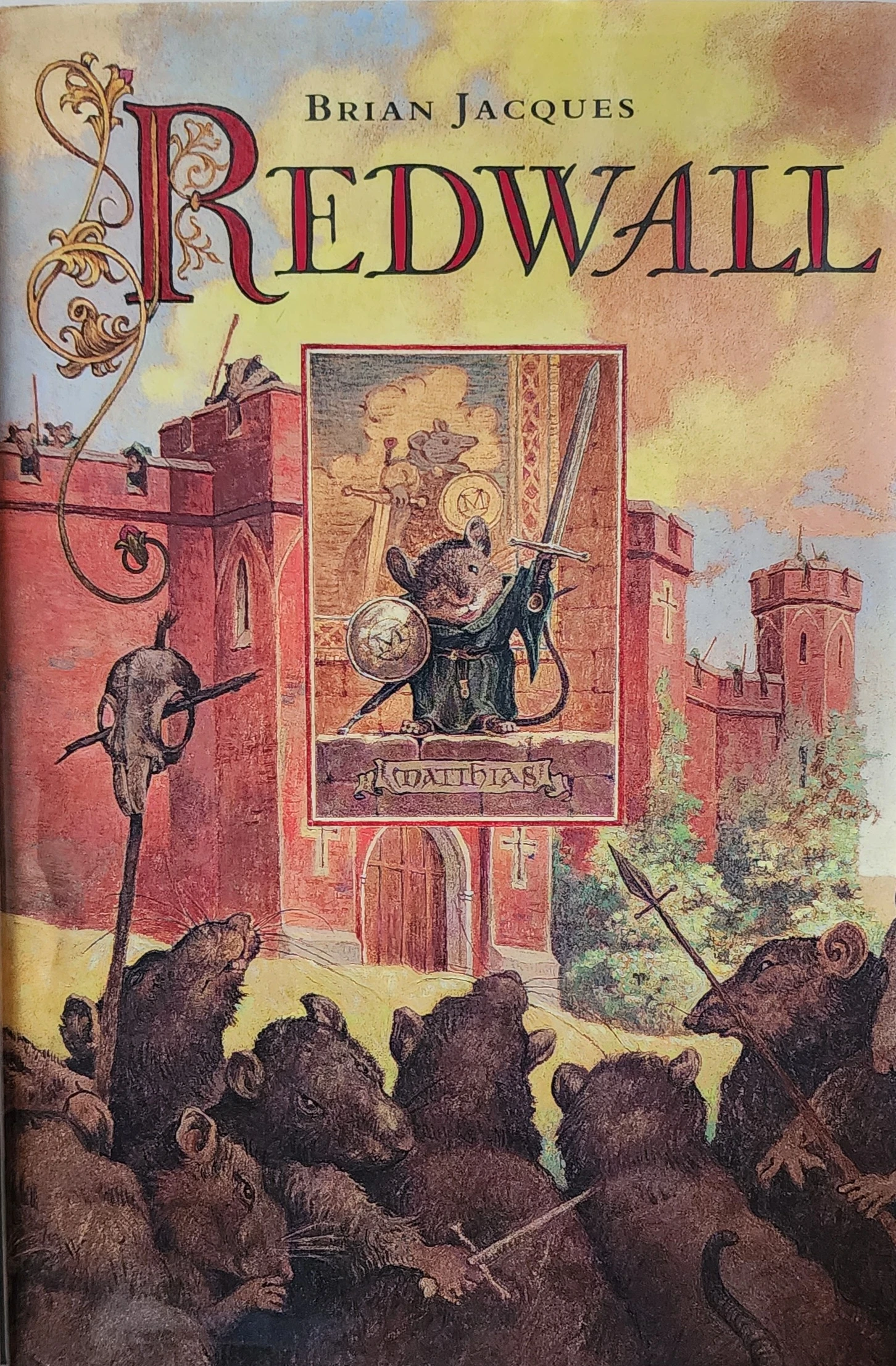 A young mouse
named Matthias lives in the peaceful Abbey of Redwall, inhabited by several
other creatures ranging from squirrels to badgers. The Abbey is a place of
peace for any creature seeking refuge. However, peace doesn’t last forever when
the rat known as Cluny the Scourge arrives seeking to take Redwall Abbey as his
own personal castle. Matthias, determined to fend off Cluny from taking
Redwall, takes it upon himself to search out the mythical sword of the
legendary Martin the Warrior. Matthias must follow a trail of clues left behind
by Martin in order to find the sword. His adventure leads him to meet new
friends outside of Redwall including a hare, a tribe of war shrews, and an owl.
After consulting the owl (a friend of the hare) of the whereabouts of the adder
Asmodeus (who stole the sword of Martin), Matthias seeks out the adder.
Matthias finds the sword, which he then uses to slay the adder and rushes back
to Redwall with his shrew friends. The books ends in a final battle and
Matthias defeats Cluny by cutting the ropes of the giant tower bell which then
falls onto the rat.
A young mouse
named Matthias lives in the peaceful Abbey of Redwall, inhabited by several
other creatures ranging from squirrels to badgers. The Abbey is a place of
peace for any creature seeking refuge. However, peace doesn’t last forever when
the rat known as Cluny the Scourge arrives seeking to take Redwall Abbey as his
own personal castle. Matthias, determined to fend off Cluny from taking
Redwall, takes it upon himself to search out the mythical sword of the
legendary Martin the Warrior. Matthias must follow a trail of clues left behind
by Martin in order to find the sword. His adventure leads him to meet new
friends outside of Redwall including a hare, a tribe of war shrews, and an owl.
After consulting the owl (a friend of the hare) of the whereabouts of the adder
Asmodeus (who stole the sword of Martin), Matthias seeks out the adder.
Matthias finds the sword, which he then uses to slay the adder and rushes back
to Redwall with his shrew friends. The books ends in a final battle and
Matthias defeats Cluny by cutting the ropes of the giant tower bell which then
falls onto the rat.
I chose this
book because it was one of the first books I actually enjoyed reading as a kid.
The first time I read this book was in elementary school around 5-6th
grade but it was difficult for me. The reason why I liked this book is it is
full of adventure and mystery in finding the sword of Martin. The text is more
appropriate for Middle school kids as the grade level equivalent of it is 7.8
and the Lexile measure is 800. While the writing of the book is pretty straight
forward there are some more graphic parts that include violence and death. The
book is also over 300 pages long of
fairly small text so I would see this used more in the 8th grade
level.
Teaching
Ideas:
1.
Analyzing which creatures are
depicted as being good and which are depicted as being bad. How do the
qualities of the animals carry over into their character?
2.
The book also has grand feasts in
it and descriptions of some pretty delicious food. There is also a Redwall
Cookbook that can be purchased online. I think it would be cool to do a
“Redwall Feast” to end the book with the class in which they could take on the
role of a species or character and eat the food that is described in the book.
3.
There are also instances of riddles
in poem form in the book written by creatures. The students could write their
own riddles to be shared at the “Redwall Feast”. They could even turn their
poetry into a song to be sung.
Obstacles:
There are some
gruesome parts in the book such as someone being stabbed multiple times and
being left in the ditch to die. Another is Cluny’s soldiers being scalded to
death with boiling water when Redwall pours it into a tunnel Cluny’s men
created trying to dig their way into the Abbey.
Wednesday, February 10, 2016
Readicide Response
I enjoyed this book and will most likely look to it more as I teach my students in order to bring interest back into reading. I had always felt the mood and effects of this phenomena Gallagher calls "Readicide" but I never could figure out why this was happening to my fellow students and I. It was nice to have Gallagher point out some factors that have caused this "Readicide" such as valuing test takers over development of readers, limiting authentic reading experiences, overteaching books, and underteaching books. In my experience I have had had both ends of the spectrum from under to overteaching of literature. One memory I have is from ninth grade learning about To Kill a Mockingbird. My teacher loved this book so much and as a result we spent about two months on the book analyzing everything about it. When Gallagher said the quote "Would you stay in a movie theater if the projectionist stopped the film 22 times", I could definitely relate (61). Despite spending so much time on the book, I now remember very little about the book except for the terrible memories of the unit never ending.
I found it intriguing, yet not too surprising, that students who read the most for fun scored highest on standardized tests (35). When I was in high school, reading for fun never seemed to be emphasized and we never had any sort of SSR reading time in place in any of the classes. I believe that as a English teacher, I will try my best to incorporate time into my classes to allow students to read their own selected books that are interesting to them. I also hope to over time accumulate many books to have in my class for my students so that I can, as Gallagher put it, "bring the library to the students" (52).
I also enjoyed the idea of augmenting books with authentic, real world text (46). As a Social Studies major, I found this to be an awesome idea because not only can students improve their reading but they can become more informed about events happening in their town, country, and world.Another helpful tip from the book was the idea of "framing" the text by providing a purpose for the reading and providing students with the necessary information to be able to understand the reading (96).
I found it intriguing, yet not too surprising, that students who read the most for fun scored highest on standardized tests (35). When I was in high school, reading for fun never seemed to be emphasized and we never had any sort of SSR reading time in place in any of the classes. I believe that as a English teacher, I will try my best to incorporate time into my classes to allow students to read their own selected books that are interesting to them. I also hope to over time accumulate many books to have in my class for my students so that I can, as Gallagher put it, "bring the library to the students" (52).
I also enjoyed the idea of augmenting books with authentic, real world text (46). As a Social Studies major, I found this to be an awesome idea because not only can students improve their reading but they can become more informed about events happening in their town, country, and world.Another helpful tip from the book was the idea of "framing" the text by providing a purpose for the reading and providing students with the necessary information to be able to understand the reading (96).
Monday, February 8, 2016
Tovani's "I Read It, But I Don't Get It" Response
The first concept that stuck out to me in this book was the idea of "fake reading". From what I gathered, the meaning of fake reading seemed to be when a student could succeed in classes while reading as little as possible and fooling the teacher into thinking they have read the whole book all the while not really comprehending the depth of the text. This is how I succeeded and made it through much of my educational career thus far was by figuring out how to do the least amount of reading while still passing English classes. However, this book has highlighted this point and made me look back on my own reading experiences and I realize that I don't remember much of what I've read in the past. I know now that I was never really taught comprehension strategies in order to help me actually understand what I've read.
The next concept that I found was that of "decoding" and "word callers" (15). I myself believe that I fall into this category when it comes to reading. I simply think that if I read the words, meaning should come with it but "when reading the words alone doesn't produce meaning, word callers assume the material is too difficult and not worth the time it takes to master it" (16). I have fallen into this rut even in my higher education. If I didn't understand the reading, I tried to read it again. However, when that strategy failed I often would just give up and choose to take a hit on my grade simply because in my thinking, it wasn't worth the effort to attempt to understand it for a few grade points.
As a "fake reader" myself, I enjoyed reading about the different access tools such as thinking aloud, marking the text, the double-entry diaries, and comprehension constructors. I feel like in my education, the only thing that was emphasized was marking the text. Even then I don't remember my teachers necessarily showing us how to do it. As the book brings up, modeling for students how to use each of these strategies is important. I also like that the book included actual examples of these access tools in the appendix for reference.
While these access tools are useful for engaging with the text, I, like the students in the book, would still become confused while reading. One quote stuck out to me because it embodies the thinking I had when I ran into this problem: "They rarely stopped while reading a piece to try and repair their confusion. They kept doggedly on until they finished the 'assignment', even though they had no idea what they were reading" (36). I believed that once my eyes finished reading the last words of the assigned reading, I was thus finished and had completed my assignment.
While I had earned decent grades in most all of my English classes, I wish now that teachers would have been able to notice what I ,along with everyone other student, was doing and teach us strategies for comprehension. I think though as a teacher, it can be difficult to identify such students because we can falsely assume that since the student is earning decent grades, they are comprehending what they are reading.
For me as a future educator, I will utilize this book and model for students how to effectively read a piece of text. I will also strive to create assignments in which they must utilize their new-found comprehension of the text, rather than having them complete monotonous "book reports" that can easily be done without actually reading the book.
The next concept that I found was that of "decoding" and "word callers" (15). I myself believe that I fall into this category when it comes to reading. I simply think that if I read the words, meaning should come with it but "when reading the words alone doesn't produce meaning, word callers assume the material is too difficult and not worth the time it takes to master it" (16). I have fallen into this rut even in my higher education. If I didn't understand the reading, I tried to read it again. However, when that strategy failed I often would just give up and choose to take a hit on my grade simply because in my thinking, it wasn't worth the effort to attempt to understand it for a few grade points.
As a "fake reader" myself, I enjoyed reading about the different access tools such as thinking aloud, marking the text, the double-entry diaries, and comprehension constructors. I feel like in my education, the only thing that was emphasized was marking the text. Even then I don't remember my teachers necessarily showing us how to do it. As the book brings up, modeling for students how to use each of these strategies is important. I also like that the book included actual examples of these access tools in the appendix for reference.
While these access tools are useful for engaging with the text, I, like the students in the book, would still become confused while reading. One quote stuck out to me because it embodies the thinking I had when I ran into this problem: "They rarely stopped while reading a piece to try and repair their confusion. They kept doggedly on until they finished the 'assignment', even though they had no idea what they were reading" (36). I believed that once my eyes finished reading the last words of the assigned reading, I was thus finished and had completed my assignment.
While I had earned decent grades in most all of my English classes, I wish now that teachers would have been able to notice what I ,along with everyone other student, was doing and teach us strategies for comprehension. I think though as a teacher, it can be difficult to identify such students because we can falsely assume that since the student is earning decent grades, they are comprehending what they are reading.
For me as a future educator, I will utilize this book and model for students how to effectively read a piece of text. I will also strive to create assignments in which they must utilize their new-found comprehension of the text, rather than having them complete monotonous "book reports" that can easily be done without actually reading the book.
Wednesday, February 3, 2016
What is Social Justice? Response
I found this article through a series of Google searches and found it to be informative for giving me ideas about what exactly social justice is and how it can be used in the classroom. While there are probably dozens of different definitions for the term "social justice", the article defines it as "recognizing and acting upon the power that we have for making positive change". I find social justice is an important aspect to be considered when teaching any subject. I believe that the issues of social justice taught in classes give a deeper meaning to what the students are learning. They are no longer learning something just for the sake of knowledge but rather are learning something that may motivate them to change our society for the better. The article suggests that we as teachers can "give students opportunities for seeing how positive change happens and how they can be both actors and leaders in creating change". However, with such topics being brought up in a classroom, the conversations may turn to heated debates between students. As the article states "it is important to choose topics about which you feel you can be pedagogically neutral as you support students' own journey of learning how to be critical thinkers and forming their own opinions". The last thing I would want to happen is to have a student get into a pissing match with me over a topic they are motivated about. However, this also may be a golden opportunity for another teacher to join the class in a team teaching method to display to students how to conduct an informed well mannered discussion about issues with someone who has a differing opinion. I also enjoyed the section about creating authentic assessments. I think especially if we are incorporating social justice in our teaching, why not have the students actually get involved? For example, if there is a social justice issue in the school, make it an assignment to have the students write a letter to the principal. I think this shows students that they have a voice in their world and they may be more motivated in doing the work because they are invested in the work.
Here is a link to the article I found:
http://www.edutopia.org/blog/creating-classrooms-for-social-justice-tabitha-dellangelo
Here is a link to the article I found:
http://www.edutopia.org/blog/creating-classrooms-for-social-justice-tabitha-dellangelo
Subscribe to:
Comments (Atom)