Friday, March 18, 2016

Learning Letter

This quarter has been pretty rough on me as far as work load goes. Despite the larger-than-normal work load for this quarter, I can look back and be proud of what I have accomplished. The book talks were one of my favorite things I found in this class, merely because it is interesting to hear about all these books that I could read in the future, use in my classroom, or recommend a student to read one. I also found it valuable to take one of my favorite books (Redwall) and use it for a book talk along with exploring the options for using it in teaching.
                I found the mini-lesson to be a great boost to my confidence in myself as a future educator. Every once in a while I get bogged down with school and wonder whether or not I would be a good teacher. However, standing up in front of my peers, taking on the role of teacher felt more natural and I feel as though that mini-lesson was the strongest part of this quarter.
                The unit plan, on the other hand, kicked my butt. It is these sorts of projects that make me question whether or not I would like to be a teacher. I know that I, along with everyone else, felt like it was the most tough, yet rewarding project I’ve ever had to complete. I know that my planning skills are not quite up to par, but in doing this activity, I was able to see where my weaknesses are and explore ways in which to improve them.
                I really enjoyed getting into a big circle and having discussions in this class. I found the reading about the “Pedagogy of the Oppressed” and the “discussion in a Democratic Society” to be the most helpful in my development as a teacher. I want to be able to recognize when I am employing the “banking” system and to involve my students more in their learning, rather than me just giving them facts to memorize. I also would like to incorporate more group discussions into my future classroom after reading the previous article and the model that ENGL 493 set for how discussions should look.

                My participation in this course was less than what I could have done. This has influenced me in how I think about myself as a teacher because I know that I will need to stay on top of things when my students are relying on me. This quarter has been quite the wakeup call for the procrastinator inside me and I will use this experience as a reminder to further improve my time management skills.

Wednesday, March 9, 2016

"In The Name Of God" By Paula Jolin Response

This book was both fascinating to me and also difficult to read. I was and still really am not too familiar with how culture works in the Middle East, specifically for this book, in Syria. It was enlightening to see the daily interactions of Nadia and her cousins with their different perspectives. Growing up in the United States, it is very foreign for me to envision a female needing a male to go with them in order to be safe. And even when a women has a male figure to go with them, there is the possibility of danger wherever you go. It is hard to fathom these things and the long standing conflict between Israel and the Palestinians because I did not grow up in that culture and haven't been thoroughly educated about the conflict. While there are many difficulties and administrative problems with teaching this book, due to its content, I think it would be an enlightening read for students. So often we are taught one side of a story without knowing the experiences and feelings of another group. I feel that this book is able to capture the sorts of feelings of resentment towards Israel and the United States' involvement with the situation. However, I'm not sure how I would necessarily teach this book in an English class. As a social studies major, I feel that this book may be better served and utilized in a social studies class, or more specifically, a current world affairs class. If the school would allow the reading of this book, I think it could be a unique opportunity for a social studies teacher and English teacher to collaborate and create a unit together that uses this book. That way the students can analyze the text in the English class but be able to have an insight into the culture for their social studies/ current world affairs class.

William Shakespeare's Romeo & Juliet

I am one of the few students who was taught Romeo and Juliet in high school English class (the sarcasm is strong with this one). While nearly every student is taught Romeo and Juliet in high school, the question becomes "Is this something I will teach my students?". If the school I'm working in already has it in the curriculum that i'm required to follow then yes, of course, I will teach it. But, if I wasn't necessarily required to teach it, I believe I would still do so. I feel like this text is one that if my students went on in their education without it, they would be those strange individuals that people would exclaim at them, "You haven't read Romeo and Juliet?!?". I believe that this play is one that many high school students can easily relate to because Romeo and Juliet are adolescents who go against their family's wishes and pursue their love for each other. However, I think the key for teaching this play is to make it interesting for the students. One thing that comes to my mind is drawing a comparison to the newer popular song "Rude" by Magic! in which a man attempts to ask a girl's father for her hand in marriage but the father refuses and the man states that he will marry her anyways. I think connecting modern examples that the students can relate to more will help them to be more invested in the story of Romeo and Juliet. I think also making the lessons interactive would be a great idea and possibly re-enact some scenes for those who are more kinesthetic learners.

Wednesday, March 2, 2016

Poe Response

I think the short story that I enjoyed the most out of all the selections picked by the groups would have to be "The Tell Tale Heart". I almost found it comical how the narrator is trying to convince the reader that he is not mad because he has thought through everything in order to kill the old man. However, by him telling the reader all these things, it just further reinforces how mad he really is. I believe I also like it because it is very suspenseful to me. When the old man wakes and asks who is there while the narrator waits patiently and quietly is very suspenseful to me because I didn't know what was going to happen. Also I found the ending suspenseful as well because as the police are carrying on with their conversations about where the old man went, we see the decent into madness of the narrator as he believes that the police will hear the beating of the dead man's heart from under the floor boards. I also found it interesting that he could not kill the old man when his eyes were closed because as he said "it was not the old man who vexed me, but his Evil Eye". I think this would be a good little short story to use in the classroom as a part of a short story unit. I believe it is short enough and interesting enough to keep kids engaged and offers material for students to have discussions about the nature of the narrator's actions. One theme that could be discussed is that of paranoia and the students could look for contextual evidence in order to support whether or not they believe the narrator to be mad or paranoid. I think that this piece also offers a cool opportunity for the teacher to do an expressive reading of the piece by taking on the tone and personality of the narrator.

Monday, February 29, 2016

The Absolutely True Diary of a Part-Time Indian Response

I think that this is one of the few books I have read that kept me engaged and wanting to keep reading non-stop. I loved the very real conversation-like writing of Sherman Alexie that offers a glimpse into the life of "Junior" or Arnold. I believe that this book will definitely be one that is on my book shelf in my classroom to offer my students to read in their free time. I do believe that this book would be a great one for reluctant readers because it is a pretty easy, entertaining read that still has a great message to it. It also was entertaining to see the cartoons throughout the book that related to what the narrator was talking about and offered a deeper look into the attitude and character of Arnold. I think that this book would be good for those students who feel a little different compared to everyone else. I found myself relating to Arnold several times throughout the book and understanding how he felt at times. I believe that this also provides a look into the Native American culture and struggles that they face on a daily basis. I can't even imagine having to hitch rides or walk 22 miles to school everyday.

Some obstacles that I could see with having students read this book is some of the inappropriate content like the use of the slang term for a homosexual and also the topic of masturbation. Another obstacle might be that the subject of alcoholism is uncomfortable for some students who may have relatives struggling with this issue. Despite these obstacles, I would definitely recommend it to my students to read in their free time. I'm not sure yet whether or not I would use it in the classroom but it is a possibility.

Monday, February 22, 2016

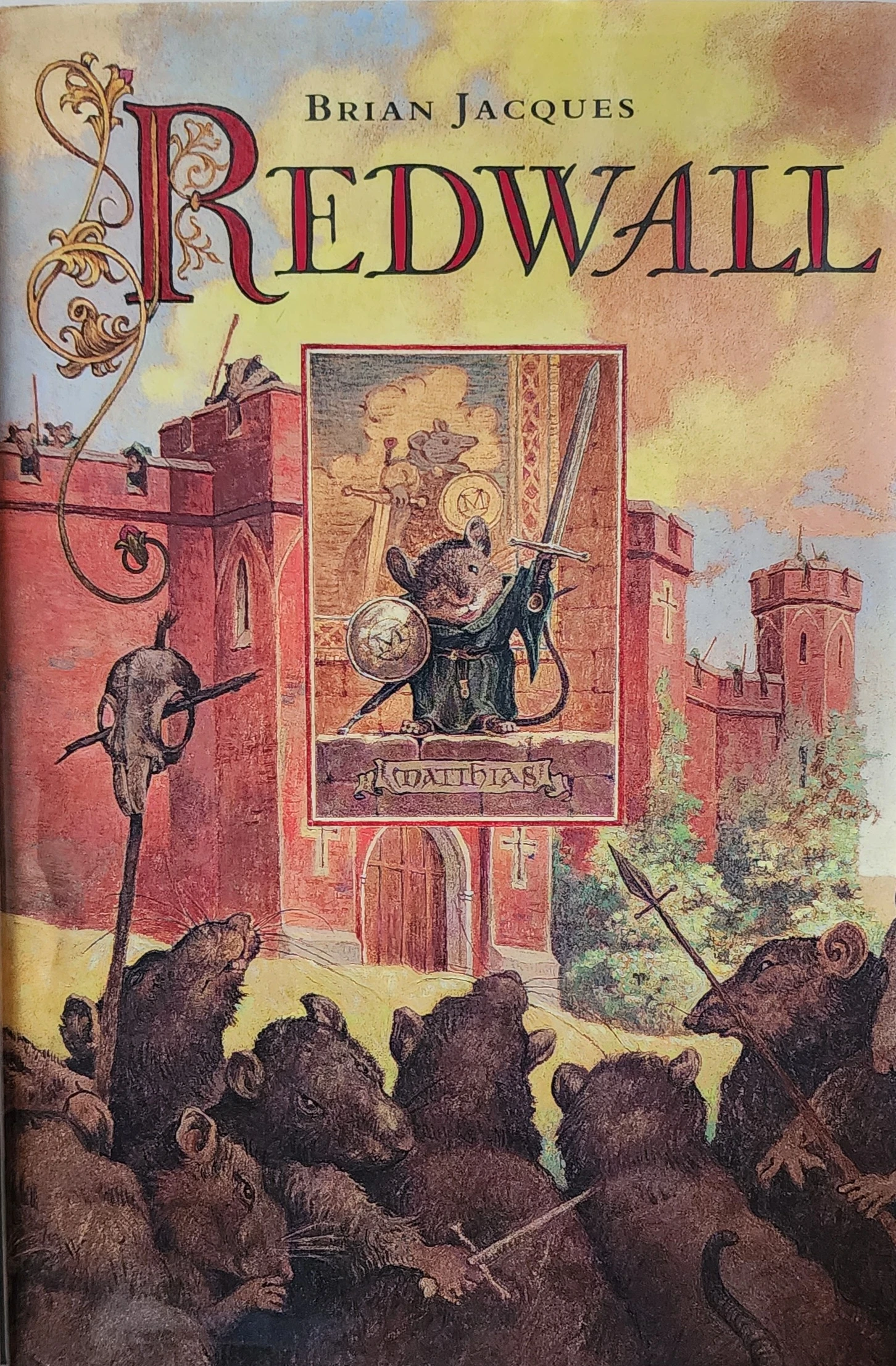
Book Talk Selection: Redwall by Brian Jacques

Redwall
By Brian Jacques
Presented by Ryan Pearson
Description of Text:
A young mouse named Matthias lives in the peaceful Abbey of Redwall, inhabited by several other creatures ranging from squirrels to badgers. The Abbey is a place of peace for any creature seeking refuge. However, peace doesn’t last forever when the rat known as Cluny the Scourge arrives seeking to take Redwall Abbey as his own personal castle. Matthias, determined to fend off Cluny from taking Redwall, takes it upon himself to search out the mythical sword of the legendary Martin the Warrior. Matthias must follow a trail of clues left behind by Martin in order to find the sword. His adventure leads him to meet new friends outside of Redwall including a hare, a tribe of war shrews, and an owl. After consulting the owl (a friend of the hare) of the whereabouts of the adder Asmodeus (who stole the sword of Martin), Matthias seeks out the adder. Matthias finds the sword, which he then uses to slay the adder and rushes back to Redwall with his shrew friends. The books ends in a final battle and Matthias defeats Cluny by cutting the ropes of the giant tower bell which then falls onto the rat.
Rationale:
I chose this book because it was one of the first books I actually enjoyed reading as a kid. The first time I read this book was in elementary school around 5-6th grade but it was difficult for me. The reason why I liked this book is it is full of adventure and mystery in finding the sword of Martin. The text is more appropriate for Middle school kids as the grade level equivalent of it is 7.8 and the Lexile measure is 800. While the writing of the book is pretty straight forward there are some more graphic parts that include violence and death. The book is also  over 300 pages long of fairly small text so I would see this used more in the 8th grade level.
Teaching Ideas:
1.      Analyzing which creatures are depicted as being good and which are depicted as being bad. How do the qualities of the animals carry over into their character?
2.      The book also has grand feasts in it and descriptions of some pretty delicious food. There is also a Redwall Cookbook that can be purchased online. I think it would be cool to do a “Redwall Feast” to end the book with the class in which they could take on the role of a species or character and eat the food that is described in the book.
3.      There are also instances of riddles in poem form in the book written by creatures. The students could write their own riddles to be shared at the “Redwall Feast”. They could even turn their poetry into a song to be sung.
Obstacles:

There are some gruesome parts in the book such as someone being stabbed multiple times and being left in the ditch to die. Another is Cluny’s soldiers being scalded to death with boiling water when Redwall pours it into a tunnel Cluny’s men created trying to dig their way into the Abbey. Also some creatures’ speech is spelled phonetically to capture their dialect and some creatures speech isn’t proper English, which may be sometimes hard to read for some.

Wednesday, February 10, 2016

Readicide Response

I enjoyed this book and will most likely look to it more as I teach my students in order to bring interest back into reading. I had always felt the mood and effects of this phenomena Gallagher calls "Readicide" but I never could figure out why this was happening to my fellow students and I. It was nice to have Gallagher point out some factors that have caused this "Readicide" such as valuing test takers over development of readers, limiting authentic reading experiences, overteaching books, and underteaching books. In my experience I have had had both ends of the spectrum from under to overteaching of literature. One memory I have is from ninth grade learning about To Kill a Mockingbird. My teacher loved this book so much and as a result we spent about two months on the book analyzing everything about it. When Gallagher said the quote "Would you stay in a movie theater if the projectionist stopped the film 22 times", I could definitely relate (61). Despite spending so much time on the book, I now remember very little about the book except for the terrible memories of the unit never ending.
I found it intriguing, yet not too surprising, that students who read the most for fun scored highest on standardized tests (35). When I was in high school, reading for fun never seemed to be emphasized and we never had any sort of SSR reading time in place in any of the classes. I believe that as a English teacher, I will try my best to incorporate time into my classes to allow students to read their own selected books that are interesting to them. I also hope to over time accumulate many books to have in my class for my students so that I can, as Gallagher put it, "bring the library to the students" (52).
I also enjoyed the idea of augmenting books with authentic, real world text (46). As a Social Studies major, I found this to be an awesome idea because not only can students improve their reading but they can become more informed about events happening in their town, country, and world.Another helpful tip from the book was the idea of "framing" the text by providing a purpose for the reading and providing students with the necessary information to be able to understand the reading (96).